
West Side Story
"For this alliance may so happy prove, To turn your households' rancour to pure love." - Shakespeare's Romeo and Juliet (Act II, Scene 2)

“When you’re a Jet, you’re a Jet all the way”
The first memory I have of West Side Story is the song “Cool” from the 1961 film version. The snaps. The sharp movement. The jazz score. The “pows!” The intense but frightened look in their eyes. I didn’t really understand what it was about then, but I knew it was special.
We had just finished reading Romeo and Juliet in my ninth-grade English class, and our teacher said we were going to watch two versions of the story and compare them. So, after spending a week watching the 1968 Zeffirelli film version, Mrs. Hart put in a VHS of what she described as a “modern, musical version of Romeo and Juliet — but this time with warring New York City gangs.”
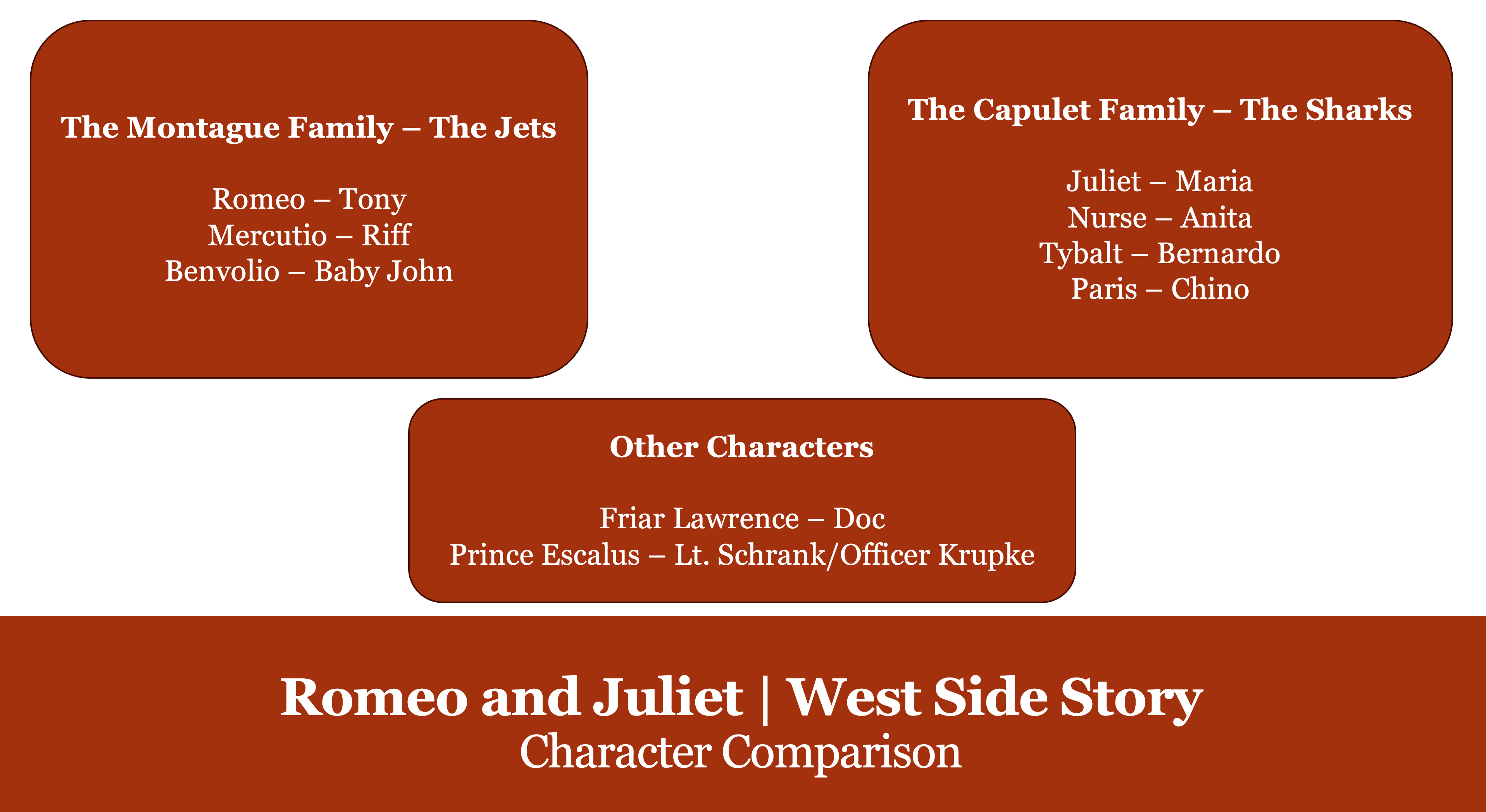
And she wasn’t too far off with her description. Sondheim sums up the show by saying this: “Romeo and Juliet transposed to New York City, 1957. The Montagues and the Capulets are two gangs, the Jets (white) and the Sharks (Puerto Rican). The lovers are Tony (Romeo), a former member of the Jets, and Maria (Juliet), the sister of Bernardo (Paris), leader of the Sharks. Riff (Mercutio) is the leader of the Jets and Tony’s best friend.”
I don’t want to do a whole deep dive into the similarities and differences between Romeo and Juliet and West Side Story, but I do think this chart will help give context to how the characters in the two shows are related:
Almost ten years before West Side Story opened, Jerome Robbins approached his friend Leonard Bernstein and young playwright Arthur Laurents to collaborate on his idea of creating a modern, musical retelling of Romeo and Juliet. The original concept was to have the two warring families represented by an Irish Catholic family and a Jewish family living on the Lower East Side of Manhattan. They struggled to get on the same page of what this show would look like. Bernstein wanted an operatic score. Laurents wrote a first draft called East Side Story. Robbins dropped out after they all realized it was basically the same plot as one of Broadway’s then-longest-running plays — Abie’s Irish Rose.
Six years later, Laurents and Bernstein were both in LA at the same time. Over a meal, they were discussing the recent increase in turf wars between teenage gangs in Los Angeles. Bernstein and Laurents quickly realized this was the solution to their previous attempt to musicalize Romeo and Juliet. They decided to stick to what they knew best and focus on the white American and Puerto Rican gangs of New York City. Robbins agreed. Bernstein initially approached his usual collaborators Betty Comden & Adolph Green to write the lyrics for what was now to be called West Side Story, but they opted to work on writing Peter Pan for Broadway star Mary Martin instead.
Enter Stephen Sondheim. The young 25-year-old protege of Oscar Hammerstein II auditioned for the team playing excerpts from his “almost first Broadway show” Saturday Night. Sondheim remembers, “I left with mixed feelings: I wanted to be asked to the party, I just didn’t want to go. The fact was, and still is, that I enjoy writing music much more than lyrics…I had the good sense to discuss this with Oscar and it was he who persuaded me that if I was offered the job, I should leap at it. The show had an interesting idea, he said, and here was a chance to work with three of the most gifted and experienced men in music and theater; my desire to compose could be satisfied at any time. When Lenny phoned a week later and invited me to join the crew, I duly leapt.”
“I feel charming — It’s alarming how charming I feel”
When writing the lyrics for WSS, Steve recalled “I wanted to be the first person to use a four-letter word on Broadway.” It made sense — he was writing a show about teenage gang violence and Sondheim, like he does with all of his characters, wanted them to speak in a natural way that reflects real life. Of course, this was still the 1950s and the producers were hesitant to allow such language in a Broadway musical. Also, Columbia Records, who was set to record the cast album, pointed out that they wouldn’t be able to ship the album across state lines due to obscenity laws.
Arthur creatively ended up crafting his own version of slang language for the Jets that mirrored what teenage gangs sounded like at the time. Jive slang like “frackadatrack,” “frabbajabba,” and “rigatigatum” is interspersed with other 1950s words like “cool” and “daddy-o.” In many ways, this allows the dialogue not to feel dated (since the words aren’t real) and establishes a specific tone and language for the Jets. (Side note: the only other show I can think of that does this really well is Wicked. Winnie Holzman’s book creates a highly whimsical atmosphere by taking words we already know by either adding an extra syllable or combining two words into one, i.e. “devastrated,” “Ozmopolitan,” “disturberance,” or “rejoicify.” What a simple but effective way to quickly establish the world of a show.)
Back to Sondheim’s issue with four-letter words! In the end, he simply had to replace them with more “acceptable” options. Although words like “bastard” and “damn” are retained, other lines throughout the “Jet Song” had to be changed. Now they read: “If the spit hits the fan” and “ On the whole every mother lovin’ street!” And in “Gee, Officer Krupke,” already a sharp, albeit jovial critique of parenthood and adults in leadership in the 1950s, the final line now reads “Gee, Officer Krupke — krup you!” Sondheim credits that edit to Lenny, and says “[it] may be the best lyric line in the show and [is an] improvement, since it fits the kidlike nature of the Jets better than the harsher and more realistic expletive.” Check out this amazing performance of the song from the 2021 film:
Speaking of lyrics, you can’t talk about WSS without mentioning Steve’s contempt for some of his work in the show. In his book Finishing the Hat, he says “the…regret was that many of the lyrics in West Side Story suffer from a self-conscious effort to be what Lenny deemed ‘poetic.’” Sondheim was originally to be co-lyricist with Bernstein, whose concept of lyrics were way more poetic and romantic than Sondheim’s ideal lyrics which portray characters in a more realistic manner. Although Sondheim would ultimately receive the billed credit by himself for the lyrics, he still had to struggle with Bernstein through much of the process.
By the way, I think it’s important to note three things. One, I obviously love the work of Sondheim, but even he admits that there are numerous poor lyric choices throughout WSS. He goes on at great length in several interviews and books pointing out all of his mistakes. Second, you have to remember that this was his first Broadway show, and he was definitely viewed as the most junior member of the production team. And third, like I’ve already said, he “knew from the start that [he] was getting into a collaboration with someone whose idea of lyric writing was the antithesis of [his].”
With that in mind, let’s look at “Tonight” from Act One. This song takes places in what would be the balcony scene (substitute a fire escape) in Romeo and Juliet. Originally “One Hand, One Heart” was slated for this scene, but in the end it made no sense for Maria and Tony’s initial outpourings of love, so it was moved to later in Act One to serve as the wedding scene. Steven and Lenny lifted this melody out of the “Quintet,” which had already been written, and developed it into what we hear today. Sondheim hit a big problem with this song. Tony and Maria had to be able to sing together, but Arthur had developed two very different types of language in the show — the Jets had their artificial lingo and the Sharks (and Maria/Anita) spoke in a very polite manner, almost as if reading a direct translation from Spanish to English of their lines. So, unfortunately the lyrics for the song end up sounding very formal and poetic. Check out this footage of OBC cast members Larry Kert and Carol Lawrence recreating their performance of “Tonight” for the Bell Telephone Hour in the mid-1960s.
The lyrics start out strong! The opening verse section flows naturally out of the dialogue and feels very conversational. Maria makes references to their “love at first sight” moment back at the gym and Tony alludes to ideas that were just presented in his song “Maria” right before this scene.
Maria: “Only you, you’re the only thing I’ll see, forever. In my eyes, in my words and everything I do, nothing else but you, ever!
Tony: “And there’s nothing for me but Maria, every sight that I see is Maria.”
Maria: “Tony, Tony…”
Tony: “Always you, every thought I’ll ever know, everywhere I go, you’ll be!
Maria: “All the world is only you and me!”
But then, it starts to get frustrating lyrically. Look at some of the lines that come later in the chorus section:
“For here you are, and what was just the world is a star” (huh?)
“Tonight, tonight the world is wild and bright, going mad, shooting sparks into space.” (…going mad?)
And perhaps the worst of all:
“Today, the world was just an address, a place for me to live in, no better than alright” (I’m not really sure what he even means here…)
And Sondheim agrees. He said, “I was just insecure enough…to present [Lenny] with lyrics like ‘Today the world was just an address’ and ‘I have a love,’ these sung by street kids on the pavements of New York City.” Several more examples of this highly romanticized, poetic language can be seen in the show, especially in “One Hand, One Heart” and “Somewhere.” Now, that isn’t to say that these songs aren’t beautiful or popular. I can’t tell you the countless times I’ve been asked to play “One Hand, One Heart” for weddings and anniversary parties, and “Somewhere” is one of the most heart-stirring melodies I’ve ever heard. But, these songs don’t seem to ring true within the context of the show and what we know about the characters. (Side note: “Somewhere” is often referred to as the “a” song due to the mistake Sondheim made in setting the opening phrase, placing the least important word of the line, “a,” on the highest note.)
Eventually Sondheim was able to push back against Lenny’s lyrical ideas. “Something’s Coming” was written late in the rehearsal process as a musical introduction to Tony’s character. Even though it’s a piece that still has poetic language, Sondheim deliberately chose images that Tony would have known like baseball metaphors (i.e. “cannonballing down through the sky” and “one-handed catch.”) Also, Tony is supposed to be somewhere between 16 to 18, so the lyrics contain simple and casual language. Check out this performance by Isaac Powell who played Tony in the short-lived revival directed by Ivo van Hove in 2020.
You can tell that this kind of lyric writing allows for a more natural performance that feels much closer to actual speech, which Isaac executes magnificently.
One more quick example. “A Boy Like That/I Have Love” places both of these styles of lyric writing in the same piece. Sondheim said that Anita’s part of this duet was the only song in the show where he was able to write the “lyric first and Lenny set it exactly the way it was handed to him.” It was late in the writing process of the show and their working relationship had obviously developed into more of an equal collaboration. Anita’s lyrics are very straightforward and match the style of her written dialogue. But when Maria takes over for “I Have a Love,” we are back in the earlier, romantically stylized poetry that Bernstein favord (this section was written much earlier in the process). Even though the text is simplistic, it betrays a level of maturity that a young and innocent Maria would not yet have. Thankfully, Bernstein’s gorgeous but heart-breaking music balances out the lyrics. Check out of both of these performances:
I’m always up for anything that MCC Theatre does as part of their annual Miscast Gala. Lin-Manuel Miranda and Raul Esparza will make you laugh and cry with their rendition of this duet:
If you want to hear Sondheim talk at length about the lyrics of WSS and his working relationship with Leonard Bernstein, check out the 1998 interview listed under the research resources. He has a lot to say!
“Maria…the most beautiful sound I ever heard.”
You can’t discuss West Side Story and not talk about the genius of Leonard Bernstein. Composer. Conductor. Pianist. Educator. Author. Mentor. Philanthropist. Considered by many to be “one of the most prodigiously talented and successful musicians in American history.” Some of my earliest memories of seeing an orchestral conductor or a concert pianist are from watching concerts with Leonard Bernstein on PBS. His passion for music is evident in every conducting gesture, every note of music he wrote, and every lecture he ever gave. Just watch him conducting the overture to his own musical Candide. You can see it all — his passion, musicality, technique, humor, and mastery.
The score of West Side Story is the perfect example of one of Bernstein’s aims as a composer — “trying to fuse popular and high culture.” He certainly wasn’t the first to try do this, but WSS is certainly one of the most successful examples of this in the 20th century. The score can best be described as a “blend[ing] of jazz, Latin rhythms, symphonic sweep and musical-comedy conventions in groundbreaking ways for Broadway.” It is melodically complicated, requiring a cast of teenagers who have to be both brilliant dancers and vocalists who can sing in popular styles and operatically. The genius orchestrations by Sid Ramin and Irwin Kostal also require so much from the pit musicians with highly independent solo playing, layering, mixed meters, and complex rhythms. The show originally called for 31 people in the pit, including five percussionists!
Scholars often discuss the musical complexity of the show, specifically citing Bernstein’s use of the tritone. To lean into my music theory nerdiness for a second, let’s talk about the tritone (also called an augmented fourth or diminished fifth, depending on how it is notated).
The western classical system of tonality and tuning breaks down into a set of 12 pitches that exist and then start over again - we call this the chromatic scale.

A tritone splits this scale exactly in half. So, in the above example, C4 to C5 is an octave, and the F-sharp is in the very middle, the seventh note with six pitches on either side. So the distance from C to F-sharp itself is what we call the tritone. If you want to get more specific, that distance can either be made up of three adjacent whole tones or six half steps. Throughout the creation and study of western classical music, the tritone has often been avoided for its feeling or sound of restlessness and discord. It has even been referred to as the “diabolus in musica” (or “the devil in music”). Especially in the medieval and renaissance periods, it was generally avoided — especially in sacred music. In later periods of composition, the tritone would later be included by numerous composers, especially as a musical depiction of tension and release.
Bernstein bases a lot of his music in West Side Story on the initial melody from the “Prologue” which uses the tritone:

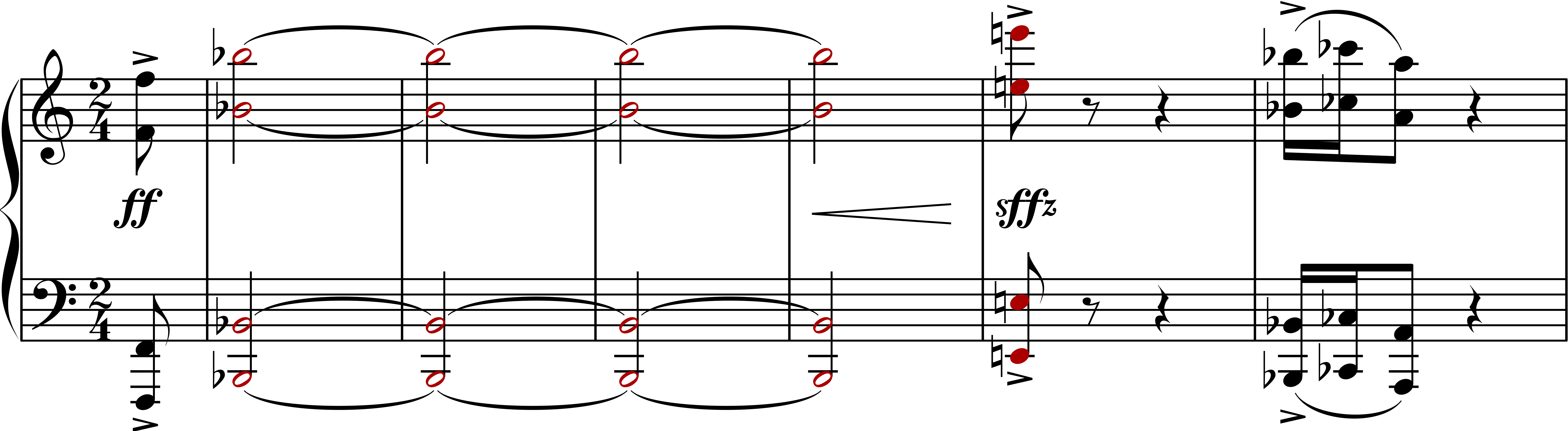
Immediately, as an audience we can hear tension. Even before any words are spoken or sung, we know that the story is going to focus on conflict — in this case between the two gangs. Bernstein brilliantly develops the use of this melody and tritones throughout the rest of the “Prologue” growing to this explosion from the full orchestra:
Steve himself said that Lenny’s best writing in the show was the ballet music. In his words, “the great strength of the music, apart from its innate excitement, is how it serves the melodrama of what’s going on.” He goes on to discuss how Bernstein and Robbins worked together as a great team when crafting the dance sequences. They both had an innate sense of what each other wanted to convey in the scenes and could almost read each others minds in terms of what was needed musically and dramatically. For example, Steve and Lenny had worked on creating different versions of a sung opening number over a period of months, but it never seemed to set the right tone for telling this story. Finally, Jerry said “Let me try,” sent them both away (preferring to usually work first without observers), and created the now unsung opening number. To see how those two elements, the score and the dance, work together, watch the “Prologue” from the 1961 film version.
Apart from some of the works of Agnes De Mille with Rodgers & Hammerstein, I can’t think of a better synthesis of music, storytelling, and dance in musical theatre.
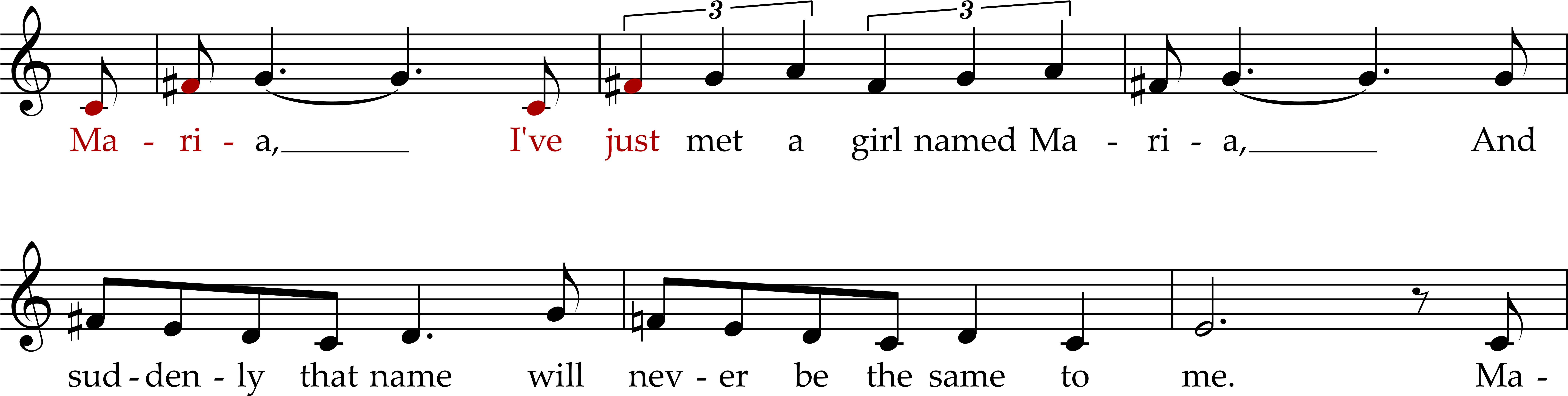
Bernstein brilliantly carries the use of the tritone into Tony’s second song in Act One, “Maria.” The song, which bridges the gap between “The Dance at the Gym” and “Tonight,” is a representation of Tony’s immediate infatuation with Maria in that all he can seem to hear or say is her name. But, by using the tritone throughout the song, we hear the foreshadowing that this relationship is doomed from the beginning.
I love Steven Spielberg’s staging of this song from the new film version — the cinematography is genius! It captures the simplicity of the moment while also grounding it in reality — much more effective than the 1961 version.
“Could be…Who knows?…”
It’s important to remember that, even though we now view West Side Story as a pivotal work in the musical theatre canon, it was not initially received that way. The reactions of critics were strong, praising it for its innovation in telling the story with dance and Bernstein’s energetic score. The show had a respectable run of 732 performances, but was definitely not the runaway hit that The Music Man was, which opened just a few months later. WSS was nominated for six Tony Awards that year, winning only two (for Robbin’s choreography and Oliver Smith’s scenic design). Bernstein famously said “Who wanted to see a show in which the first-act curtain comes down on two dead bodies lying on the stage?” And according to Sondheim, “for the last six month of its [run]…you know, it closed in New York, went out on the road, and then came back to New York for another six months. And the last six months in New York were on twofers, two tickets for the price of one.”
The entire creative team lays the wide-reaching success of the show at the feet of the movie and its subsequent cast album. Steve said, “the movie is what made the score popular.” The 1961 film was the highest-grossing film of the year and was nominated for 11 Academy Awards, winning 10. The cast album also spent 54 weeks at “number one” on Billboard's stereo albums charts, giving it the longest run at “number one” of any album in history!
Initially praised for its strong point of view on real world issues like gang warfare, immigration, and forbidden love, West Side Story has come under more scrutiny as the years have passed. Most of the criticisms I have read, and that I have myself, all have to do with the writing and portrayal of the Puerto Ricans/the Sharks. First and foremost are the numerous missteps made in the casting of the Latinx roles, i.e. Carol Lawrence in the the OBC and Natalie Wood in the 1961 film. Also, upon re-reading the original script and watching the original movie, it’s very clear that the creative team struggled to write and characterize the Sharks. Compared to the Jets, the Sharks are vaguely written and don’t receive near the amount of stage time, whereas the Jets are on stage much more often with very specific characterization of each gang member.
Also, let’s take a look at the lyrics of “America,” where we hear a conversation between Anita and Rosalia (Bernardo in the film version) where Anita praises all the qualities of living in the USA versus the “ugly island” of Puerto Rico. Read the opening verse:
“Puerto Rico,
You lovely island,
Island of tropical diseases,
Always the hurricanes blowing,
Always the population growing,
And the money owing,
And the baby's crying,
And the bullets flying…
I like the island Manhattan —
Smoke on your pipe and put that in!”
Sondheim said that he received a letter from Dr. Howard Rusk (founder of the Rusk Institute) arguing that the song misrepresented Puerto Rico, which had, in fact, a very low occurrence of tropic diseases and a lower mortality rate than the continental United States.
Several attempts have been made to rectify these issues, primarily in the major edits made for the 2009 Broadway revival. Lin-Manuel Miranda, fresh off his success of In the Heights, was asked to translate portions of lyrics and dialogue into Spanish. Laurents, who directed this revival, stated, “The musical theatre and cultural conventions of 1957 made it next to impossible for the characters to have authenticity.” In listening to the 2009 cast album and watch some footage from this revival, I find the translations to be very effective. It doesn’t completely rectify the lack of characterization for the Sharks, but it is a good start. Check out the Spanish version of “I Feel Pretty” — “Me Siento Hermosa.”
Similarly, with the 2021 film version, Spielberg, Kushner, and their team make several changes as well by keeping many of the Spanish lyrics and dialogue (without English subtitles - thankfully) and inserting a scene where the Sharks sing portions of the Puerto Rican national anthem. Despite the film being beautifully shot, sung, and acted, these changes can’t seem to solve some of the inherent problems of a show that highlights Puerto Rican culture written by “four, white, gay guys.” Check out this article by Aurora Flores-Hostos that discusses these issues much more in depth.
“There’s a place for us…”
Aside from all the problems West Side Story brings to the table, there is no denying its legacy and what it changed in the musical theatre industry. I’ve barely scratched the surface of the brilliance that Jerome Robbins brought to the show through dance or the sleek and economical book that Laurents created. That, in addition to the work of Steve and Lenny, makes this unlike any other Broadway show. Whatever you find in the show — a story about immigration, the plight of star-crossed lovers, or a cautionary tale of what happens when teenagers are left unsupervised — there is no denying the genius of its creators and what they originated.
I think I’ll wrap this post up with a number that is often omitted from productions or re-imagined - the “Somewhere” ballet. Here is Asolo Rep’s recreation of Robbins’s transformative choreography with a thoughtful introduction by Michael D. Edwards:
Sorry it took me longer to write this…summer has a way of quickly dissappearing! Next week, we’re going to look at Sondheim’s first flop — Anyone Can Whistle — here are the resources.
“What’s hard is simple, what’s natural comes hard.” -Stephen Sondheim
Research Resources (what I watched, listened to, and read):
Leonard Bernstein: A Life (by Meryle Secrest) - an exhaustive biography about the genius himself. I focused on chapter titled “Wow, I’m Famous!” (pg. 199-221), which covers Bernstein’s work on West Side Story.
Stephen Sondheim on Jerome Robbins - 2007: Interview - Stephen Sondheim interviewed for PBS' American Masters series, for the documentary “Jerome Robbins: Something to Dance About.” Directed by Judy Kinberg. Recorded on September 24th, 2007.
Stephen Sondheim on Leonard Bernstein - 1998: Interview - Stephen Sondheim interviewed for PBS' American Masters series, for the documentary “Leonard Bernstein: Reaching for the Note.” Directed by Susan Lacy. Recorded on February 26th, 1998.
West Side Story Symposium: Interview - A panel conversation with Stephen Sondheim, Leonard Bernstein, Arthur Laurents, and Jerome Robbins moderated by Terrence McNally. Recorded at St. Peter's Church in the Citicorp Building, New York City, on April 18, 1985.
Additional Resources - click here